
How to Compare Employee Transportation Vendors: A Procurement Scorecard for Sourcing Teams & Enterprises
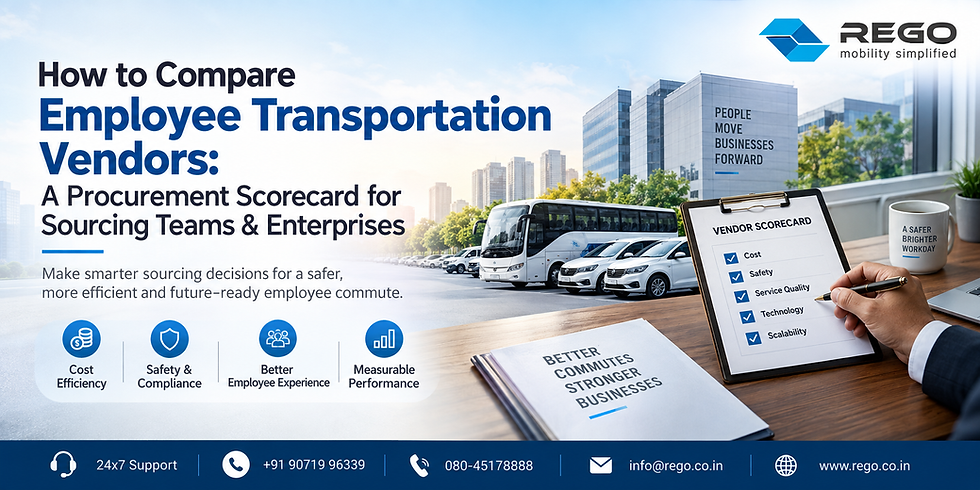
For procurement teams, choosing an employee transportation vendor is not simply a matter of comparing cab rates. The real procurement question is: Which vendor delivers the best combination of cost, safety, service reliability, technology and scalability?
This question is becoming increasingly important as Indian enterprises expand their office footprint. In Q2 2026, India's office market recorded 24.6 million sq. ft. of absorption, its highest-ever quarterly level, taking H1 2026 absorption to a record 45.5 million sq. ft. Global Capability Centres (GCCs) accounted for 43% of H1 2026 leasing.
More offices and higher attendance mean more employees travelling to workplaces and potentially larger employee transportation budgets.
A procurement scorecard helps sourcing teams move from “Which vendor quoted the lowest?” to “Which vendor offers the strongest measurable value?”
Employee Transportation Procurement: What Should You Score?
A structured scorecard allows every vendor to be evaluated against the same criteria.
A practical 100-point framework can be:
Evaluation Parameter | Weight | What Procurement Should Check |
Cost & Total Cost of Ownership | 20% | Rates, additional charges, utilization, and annual TCO |
Safety & Security | 20% | Driver verification, vehicle safety, and emergency response |
Compliance | 15% | Vendor, vehicle, and driver documentation |
SLA & Service Quality | 10% | Punctuality, trip completion, and response times |
Fleet Quality | 10% | Fleet age, availability, and replacement capacity |
Technology | 10% | GPS, tracking, automation, and integrations |
Driver Management | 5% | Training, verification, and performance |
Scalability | 5% | Capacity, cities, and future expansion |
Reporting & Analytics | 3% | Cost, utilization, and SLA reporting |
Experience & References | 2% | Enterprise experience and client references |
Total | 100% |
The weights should be customized according to the organization's operating model. A 24/7 GCC with significant night-shift transportation, for example, may assign greater importance to safety, security, and fleet availability.
Cost & TCO: Is the Cheapest Vendor Really the Cheapest?
The first mistake in transportation procurement is comparing only the per-kilometer or per-trip rate.
The more useful metric is Total Cost of Ownership (TCO).
The commercial evaluation should include:
Per-km/per-trip charges
Fixed monthly charges
Minimum billing commitments
Waiting charges
Toll and parking costs
Night-shift charges
Extra-kilometer charges
Cancellation charges
Route-deviation charges
Technology/platform fees
Replacement vehicle charges
Applicable taxes
A procurement example
Suppose Vendor A quotes a lower per-km rate but has higher waiting charges, additional technology fees, and weaker vehicle utilization.
Vendor B quotes slightly more per kilometre but includes technology, provides better route optimization, and achieves higher occupancy.
Vendor A may have the lower quotation, but Vendor B may have the lower annual TCO.
This is why procurement should request an annual cost model, not just a rate card.
The need to examine utilization is particularly relevant for GCCs. A 2026 RouteMatic study covering 100+ GCCs and more than 1 million employee commutes found that 60% of GCCs still manage employee transport without an integrated system.
For procurement, that raises a practical question:
Can the vendor use technology to reduce empty kilometres, improve occupancy and match fleet capacity with changing employee demand?
Employee Commute: Why Service Quality Is a Business Metric
Transportation directly influences the employee experience.
MoveInSync's India on Wheels 2026 report found that India's average one-way commute crossed 64 minutes in 2025. The report analyzed commute patterns across major Indian cities and compared 2025 with the previous year.
That is not merely a travel statistic. For an enterprise with thousands of employees, delays and inefficient routes can translate into significant cumulative employee time.
CBRE's research also shows why commuting should matter to corporate decision-makers. Its 2025 Outlook for Office Attendance found that 57% of respondents cited commute time as a barrier to greater office attendance.
Therefore, procurement should score vendors on measurable service outcomes:
KPI | What to Measure |
On-time performance | % of pickups/drops completed on time |
Trip completion | Completed vs. scheduled trips |
Vehicle availability | Vehicles available as committed |
Breakdown rate | Breakdowns per defined number of trips |
Replacement time | Time taken to deploy backup vehicle |
Complaint resolution | Average resolution time |
Route adherence | Planned vs. actual route |
Driver attendance | Scheduled vs. available drivers |
These should eventually become contractual Service Level Agreements (SLAs).
Employee Shuttle Service: Can the Vendor Optimize Demand?
An employee shuttle service should not simply supply vehicles. It should help the enterprise optimize its transportation network.
This becomes important as office attendance patterns fluctuate.
A procurement team should ask whether the vendor supports:
Dynamic route planning
Route optimization
Shared rides
Demand forecasting
Live vehicle tracking
Digital trip allocation
Seat utilization monitoring
Geofencing
Employee notifications
Automated attendance
Real-time dashboards
The objective is to move from:
“How many vehicles can you provide?”
to:
“How efficiently can you transport our workforce?”
That distinction can have a direct impact on fleet utilization and transportation costs.
Safety & Security: Put Risk Into the RFP
Safety should never be treated as a secondary vendor-selection criterion.
For a sourcing team, the question is not whether a vendor says it is "safe." The question is whether the vendor can demonstrate and document its safety processes.
Evaluate:
Driver background verification
Valid driving licenses
Driver training
Vehicle fitness certificates
Insurance
Preventive maintenance
GPS tracking
SOS / panic systems
Route-deviation alerts
Emergency response
Incident reporting
Night-shift protocols
Female employee safety measures
The scorecard should distinguish between “policy exists” and “performance can be demonstrated.”
Ask vendors for historical safety KPIs, incident-management processes, and sample reports wherever commercially appropriate.
Compliance & Office Transport: Verify Before You Award
A competitive quotation should never compensate for a compliance gap.
Procurement should verify three levels of documentation.
Vendor-level compliance
GST and PAN
Company registration
Insurance
Applicable statutory registrations
Contractual documentation
Vehicle-level compliance
Registration Certificate
Commercial permit
Insurance
Fitness certificate
Pollution certificate
Applicable tax and permit documents
Driver-level compliance
Driving license
Background verification
Police verification where applicable
Identification documents
Training records
The sourcing team should define mandatory pass/fail criteria before commercial scoring begins.
Technology: Does the Platform Give Procurement Visibility?
Technology should not be evaluated merely because a vendor has an app.
Procurement should evaluate whether the technology generates actionable operational and financial data.
Look for:
Live GPS tracking
Digital trip allocation
Employee notifications
Geofencing
Driver monitoring
Automated attendance
Route analytics
Vehicle utilization
Occupancy data
Cost-per-trip reporting
Cost-per-employee reporting
Automated invoicing
API/HRMS integration
SLA dashboards
This is especially important because RouteMatic's 2026 GCC study found that 60% of GCCs operate without an integrated transport system.
A technology-enabled employee commute vendor can therefore potentially give procurement teams better visibility into where transportation spend is going and where efficiency can be improved.
Scalability: Can the Vendor Support Your Next 3 Years?
Vendor selection should reflect future business requirements, not just today's fleet requirement.
CBRE's August 2026 India Office Occupier Survey, based on more than 200 CXOs surveyed between April and June 2026, found that 77% of occupiers expect their India office portfolio to expand over the next two years. Importantly for mobility planning, 70% said commute infrastructure is a priority when selecting office locations.
For procurement, this means the vendor should be assessed on:
Fleet capacity
Multi-city operations
New office launches
Additional shifts
Peak-hour capacity
Backup fleet
Driver availability
Emergency capacity
Route expansion
Tier-II city coverage
A vendor that performs well at the current scale but cannot support expansion may create another sourcing exercise within a year.
Sustainability: Turn ESG Claims Into Procurement Metrics
Sustainability is increasingly becoming part of enterprise decision-making.
CBRE's Q2 2026 office data shows that 73% of leasing activity was concentrated in green-certified buildings, demonstrating the growing importance of sustainability in the corporate real-estate ecosystem.
For transportation procurement, sustainability can be measured through:
EV availability
Shared-ride utilization
Vehicle occupancy
Route efficiency
Fuel consumption
Emissions reporting
Green-kilometre tracking
A March 2026 report on employee transportation fleets highlighted the potential scale of EV savings: more than 400 EVs across Bengaluru and Pune were reported to save approximately 65,400 litres of fuel every 15 days, equivalent to about 15.7 lakh litres annually.
However, procurement teams should treat such numbers as vendor-specific reported outcomes, not universal savings benchmarks.
The right question is:
“What measurable fuel, cost and emissions reduction can you demonstrate for our specific fleet?”
How Procurement Should Shortlist the Final Vendor
Once the RFP responses are received, follow a structured evaluation process:
Define requirements ⟶ Issue RFI/RFP ⟶ Compliance screening ⟶ Technical and safety scoring ⟶ Technology demonstration ⟶ TCO comparison ⟶ Reference checks ⟶ Commercial negotiation ⟶ SLA finalization ⟶ Contract award
The most important rule is to complete the technical and compliance evaluation before allowing price alone to dominate the decision.
The Procurement Scorecard: Final Decision Checklist
Before awarding an employee transportation contract, procurement teams should be able to answer:
Cost: Have we calculated the complete annual TCO?
Utilisation: Are we paying for unused fleet capacity?
Safety: Can the vendor demonstrate its safety controls?
Compliance: Are all critical documents verified?
Service: Can the vendor prove historical SLA performance?
Technology: Can we access real-time operational data?
Scalability: Can the vendor support future growth?
Sustainability: Are ESG claims backed by measurable data?
Governance: Are escalation mechanisms and responsibilities documented?
A Simple Procurement Rule
Score → Verify → Compare → Negotiate → Contract → Measure
The right employee transportation vendor is not necessarily the vendor with the lowest quotation. It is the partner that provides the best measurable balance of cost, safety, employee experience, operational reliability, technology, and scalability.
For sourcing teams, that is the difference between buying transportation capacity and strategically managing corporate mobility.


Comments